Introduction
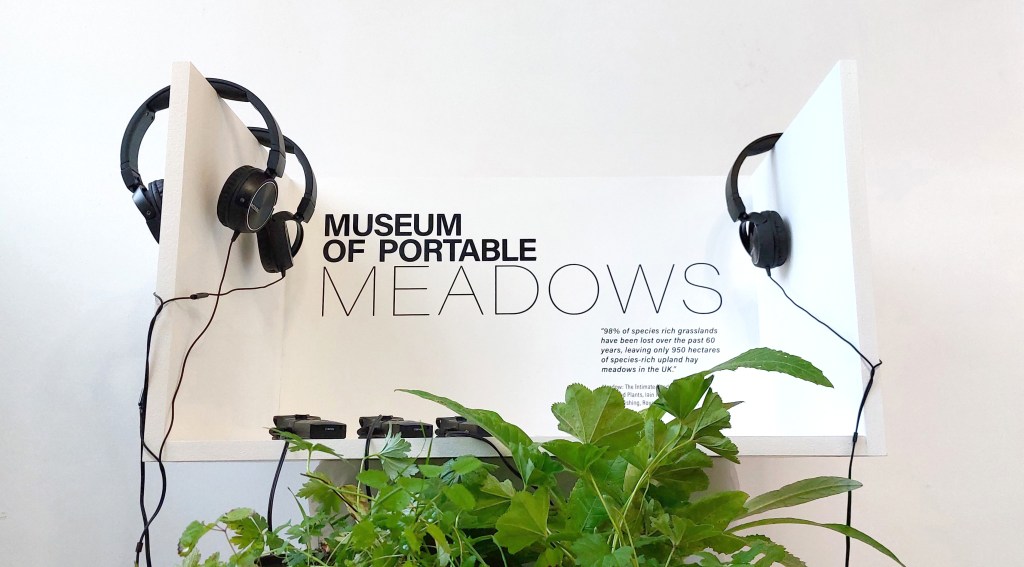
“Museum of Portable Meadows” communicates to audiences the immediacy of climate change, habitat and species loss. It is an artwork where the audience are encouraged to fall in love with nature in order to be ready to save it! Specifically, the project explores the loss of UK upland meadows and the resulting impacts on biodiversity. It has been supported by the North East Artists’ Fund (through Contemporary Visual Art Network England, CVAN North East).

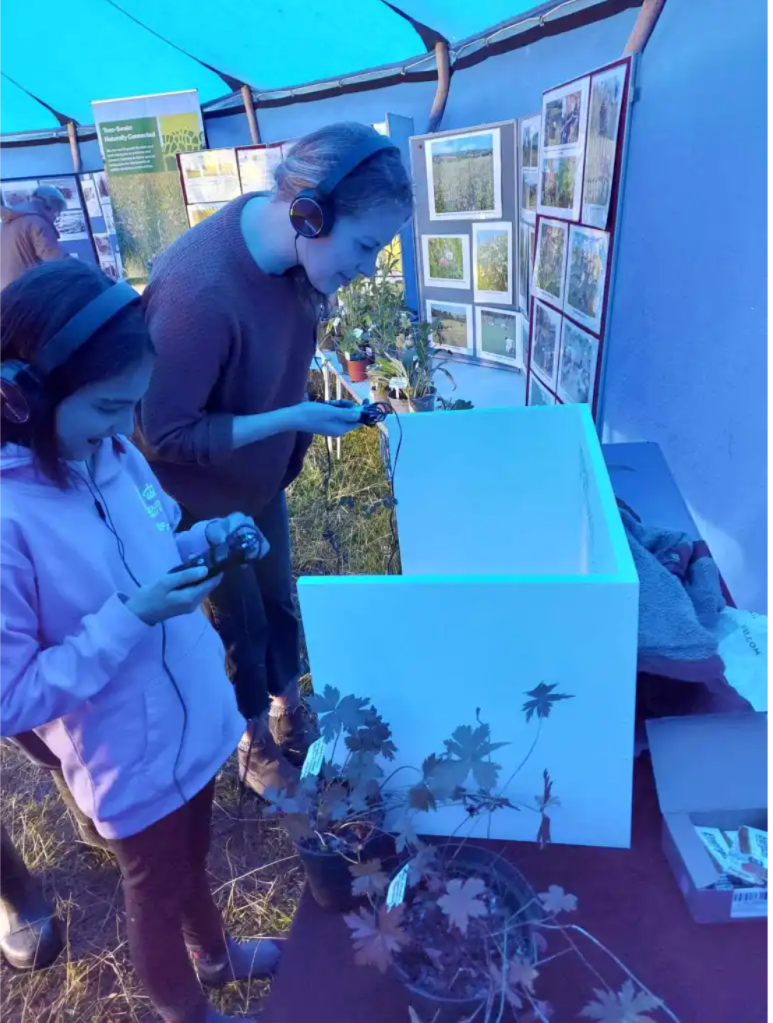
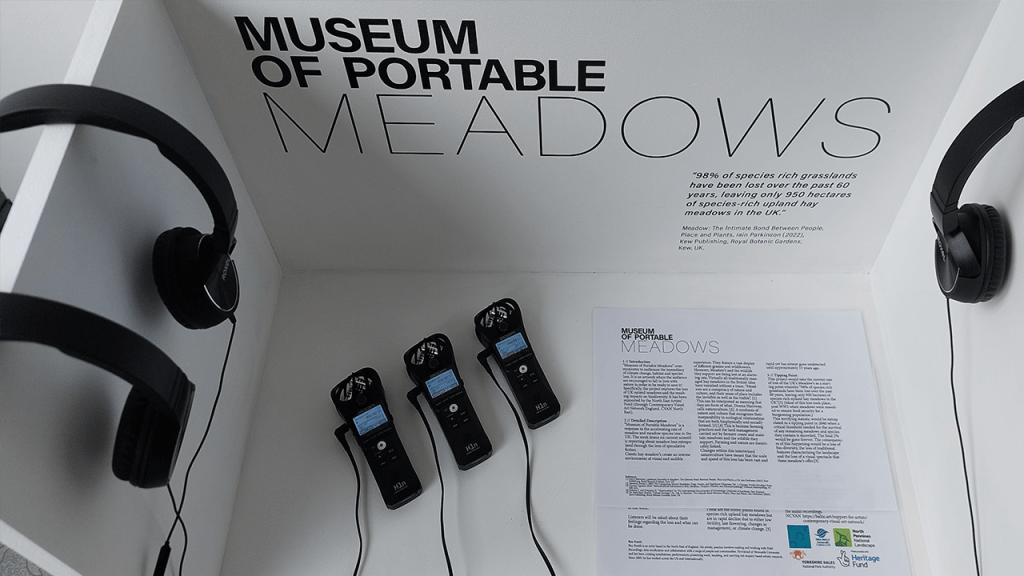
Exhibition at Meadows Day at Low Way Farm 13/07/24
Detailed Description
“Museum of Portable Meadows” is a response to the accelerating rate of meadow and meadow species loss in the UK. The work draws on current scientific reporting about meadow loss extrapolated through the lens of speculative fiction.
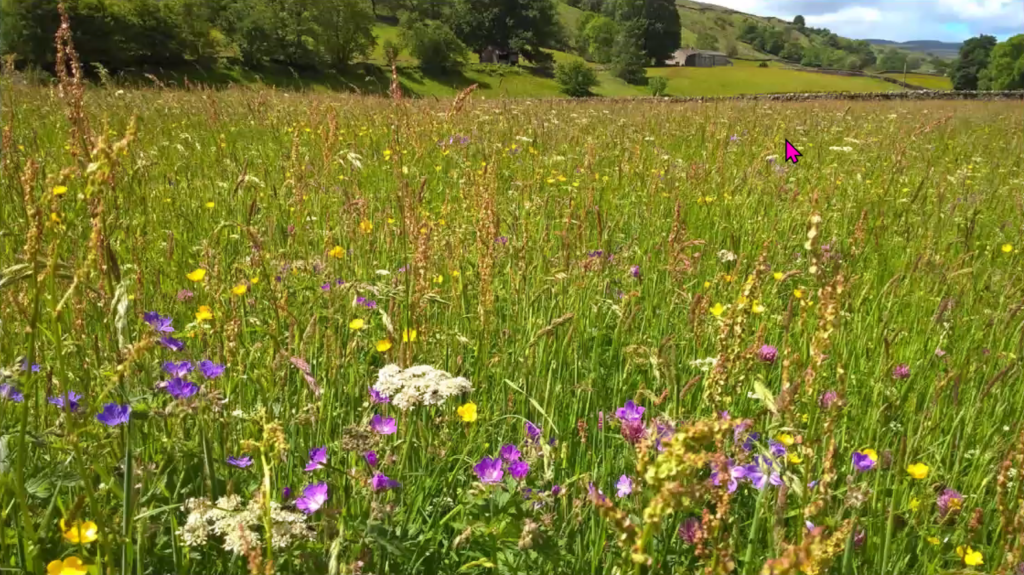
Classic hay meadow’s create an intense environment of visual and audible experience. They feature a vast display of different grasses and wildflowers. However, Meadow’s and the wildlife they support are being lost at an alarming rate. Virtually all traditionally managed hay meadows in the British Isles have vanished without a trace. “Meadows are a conspiracy of nature and culture, and their sense of place includes the invisible as well as the visible”. [1]
This can be interpreted as meaning that they are form of what, Donna Haroway, calls natureculture. [2]. A synthesis of nature and culture that recognises their inseparability in ecological relationships that are both biophysically and socially formed. [3] [4] This is because farming practices and the land management carried out by farmers create and maintain meadows and the wildlife they support. Farming and nature are inextricably linked.
Changes within this intertwined natureculture have meant that the scale and speed of this loss has been vast and rapid yet has almost gone undetected until approximately 15 years ago.
This project would take the current rate of loss of the UK’s Meadow’s as a starting point whereby “98% of species rich grasslands have been lost over the past 60 years, leaving only 950 hectares of species-rich upland hay meadows in the UK”.[5] (Most of this loss took place, post WW2 when meadows were reseeded to ensure food security for a burgeoning population.)
This terrifying statistic would be extrapolated to a tipping point in 2040 when a critical threshold needed for the survival of any remaining meadows and species they contain is exceeded. The final 2% would be gone forever. The consequences of this happening would be a loss of bio-diversity, the loss of traditional features characterising the landscape and the loss of a visual spectacle that these meadow’s offer.[5]
In this speculative exercise we imagine that the tipping point has been exceeded and the remaining 2% of meadows have been lost. The project casts the viewer / participant in the role of a future bioprospector trying to recreate and restore meadows based on archival material in order to retrieve natural resources. In this iteration of the work one document from this speculative archive is provided, a sound recording of an amazing upland hay meadow made at Hill Gill Farm, owned by Charlie and Gina Parker. The participant is asked to listen to the audio recording and engage in a dialogue with the artist about losses and restoration. This dialogue will be recorded and the recorded discussions will be included in an expanded version of the work.
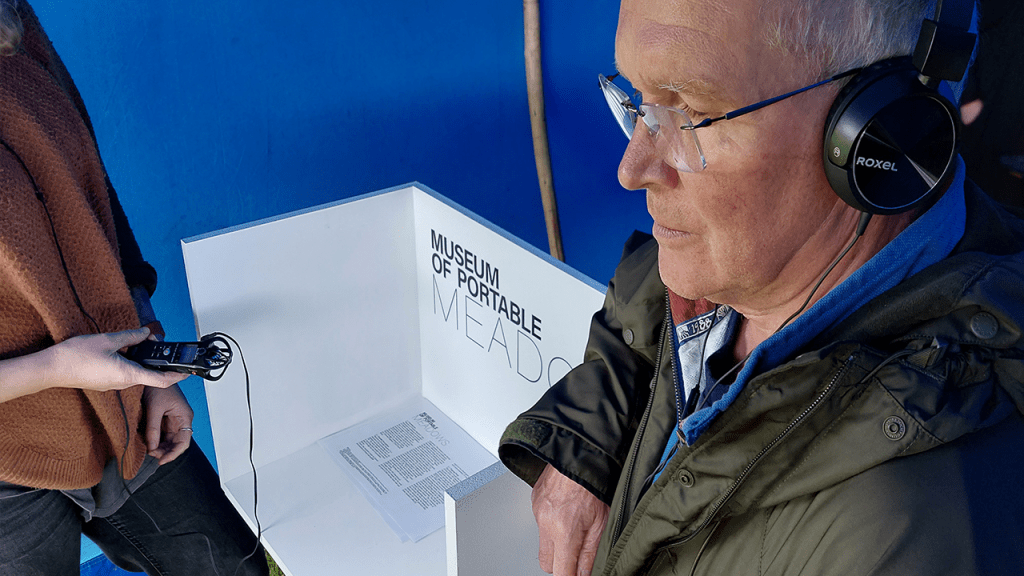
Listeners were asked about their feelings regarding the loss and what can be done.
Is restoration more difficult if not impossible to achieve after they are lost rather than when they are still in existence?
Important Plants
Plants in meadows are currently in danger of being lost due to changing agricultural practice, additions of chemical fertiliser, under management, overgrazing, agricultural policy and climate change.
These are the iconic plants found in species-rich upland hay meadows but are in rapid decline due to either low fertility, late flowering, changes in management, or climate change. [5]
Wood Crane’s Bill (Geranium sylvaticum)
Great Burnet (Sanguisorba officials)
Melancholy Thistle (Cirsium heterophyllum)
Lady’s Mantle (Alchemilla mollis)
Globe Flower (Trollius europaeus)
The aim of this project is to provide a way for audiences to become re-enchanted by and fall in love with the natural world as a necessary precursor to saving it.
This stage is a necessary precursor to taking action and effecting the changes our society needs to commit to, to bring ourselves out of this ecological and climate crisis.
Thanks to:
Charlie and Gina Parker for support with making audio recordings at Hill Gill Farm.
Ruth Starr-Keddle for supporting me to participate in her meadow surveys in the North Pennines as part of the research for this project.
Ben Freeth is an artist based in the North East of England. His artistic practice involves making and working with Field Recordings, data sonification and collaboration with a range of people and communities. He trained at Newcastle University and has been creating installations, performances, presenting work, teaching, and carrying out enquiry based artistic research. Since 2005, he has worked across the UK and Internationally.
References
[1] Gerry Sherwein, Landscape Specialist in Meadow: The Intimate Bond Between People, Place and Plants. p.123. Iain Parkinson (2022). Kew Publishing, Royal Botanic Gardens, Kew, UK
[2] Haraway, Donna J. 2003. The Companion Species Manifesto: Dogs, People, and Significant Otherness. Vol. 1. Chicago: Prickly Paradigm Press.
[3] Fuentes, Agustín. 2010. “Naturalcultural Encounters in Bali: Monkeys, Temples, Tourists, and Ethnoprimatology.” Cultural Anthropology, 25: 600–624.
[4] Malone, L and Ovenden, K. “Natureculture” in: The International Encyclopedia of Primatology. University of Auckland, New Zealand.
[5] Dr. Ruth Starr-Keddle “Upland Heritage”, Pp. 128, in Meadow: The Intimate Bond Between People, Place and Plants. Iain Parkinson (2022). Kew Publishing, Royal Botanic Gardens, Kew, UK
 Ben_Freeth